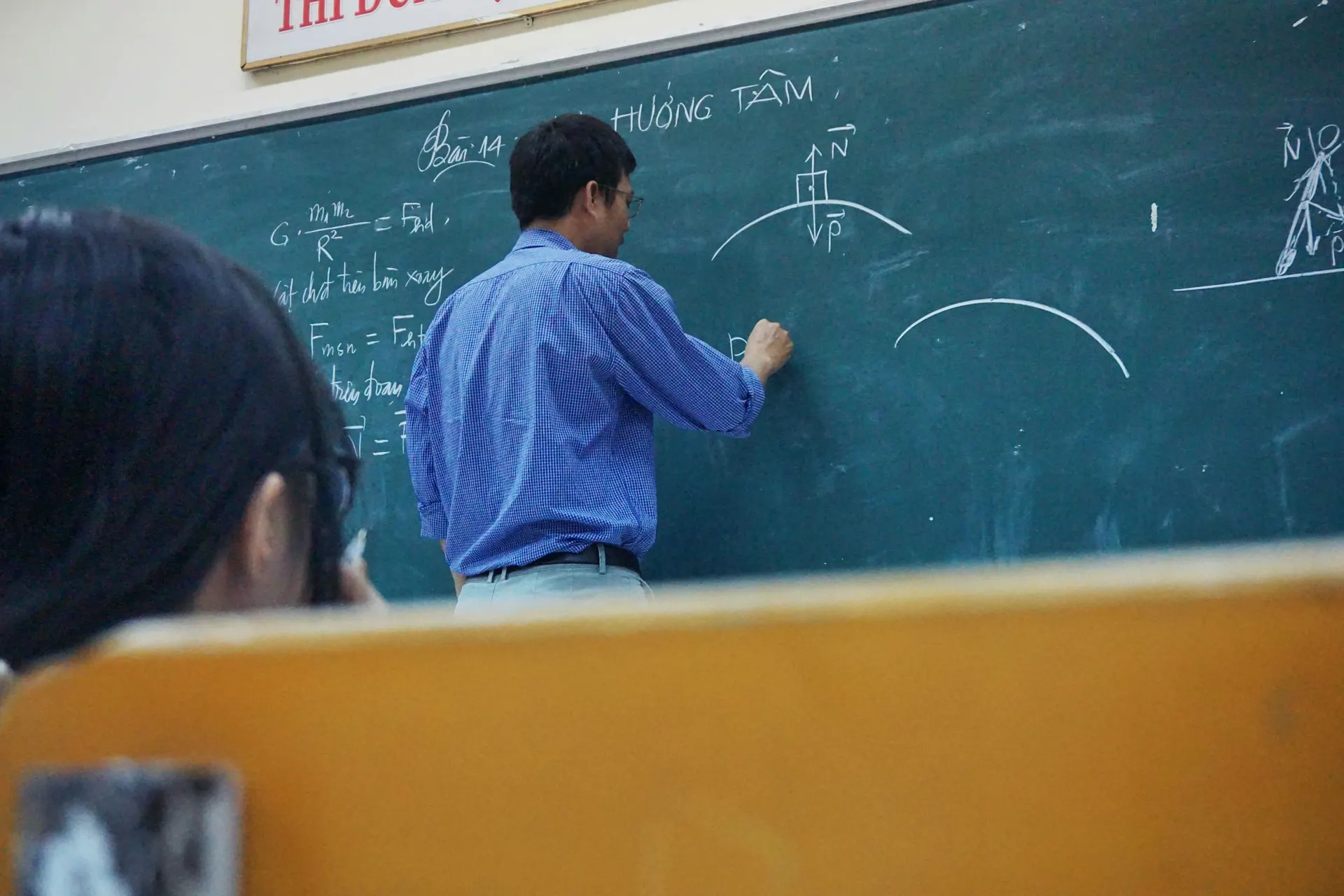
Physics Group Classes in Barcelona
Small physics groups for IGCSE, MYP, IB, A-Level and Bachillerato students, formed by year and course and running weekly through the school year. Founder-led by Suneel Gupta, MSc Physics, at our centre in Sant Gervasi and online.
Students can join at any point in the year.
Groups by course
Which group fits your child
Grades 9 and 10
IGCSE Physics · MYP 4 and 5 · 3º and 4º ESO
Forces, energy, electricity and waves, with the habit of setting out a calculation and explaining a result in words. This is where a student either gets comfortable with physics or decides it is not for them.
IB Diploma Physics
Standard and Higher Level
The full course across both years, with the data-based questions, the explanation the markschemes reward, and support for the Internal Assessment.
A-Level Physics
AQA, Edexcel, OCR and CAIE
Mechanics, fields and the practical endorsement, taught to the specification your school follows.
Bachillerato Física
1º and 2º Bachillerato · Selectividad
The Catalan Física syllabus taught in English, with the problem types that appear in the PAU practised under time.
Prefer one to one? Physics tutoring in Barcelona · Maths and physics groups
Why a group
What a physics group gives your child
More teaching time each week
A group can meet for two hours a week where one to one is often a single hour. That extra time goes into explanation and guided practice, which is where physics is learned.
Maths underneath the physics
Many students who struggle in physics are really stuck on the algebra, rearranging or units. A physicist who also teaches mathematics sees that straight away and fixes it in the lesson.
Written answers, not just numbers
Exams give marks for explaining what is happening and why. Students practise writing those answers in class and get them corrected the same day.
A fixed weekly rhythm
The same time every week, alongside the school course, so physics stays current rather than being rescued the week before a test.
Founded and led by Suneel Gupta, who still teaches.
Suneel Gupta has taught maths and physics for over thirty years and holds an MSc in Physics from the Universitat Autonoma de Barcelona. He teaches at the centre in Sant Gervasi and online. Where a specialist teaches alongside him, as for Digital SAT Reading and Writing, you are told who before you start.
A short assessment first
Before or during the first lesson, a short written check shows exactly where the gaps are. It is not an exam and there is no pass mark. It decides where we start.
Taught in English, in any system
Students come from IB, British, American, Spanish, French and German schools, in person in Barcelona and online. Students from Spanish-system schools study with us in English.
Small enough to see who is lost
One to one, or a small group. In a group the teacher still sits with each student during the session, and a student who finishes early is given harder work, not the same sheet again.
WHY A SPECIALIST
A physicist teaching physics is rarer than most parents assume
In Catalonia there is no physics teaching post to apply for. The secondary speciality is Física i Química, one combined qualification covering both subjects. On the Generalitat’s current call it carries 70 places, against 182 in Mathematics. A student who needs physics is therefore often taught by someone whose own degree is chemistry.
England shows the same pattern from the other direction. Institute of Physics research published in September 2025 found that more than half of GCSE-level physics lessons are taught by someone who did not study a physics-related subject past the age of eighteen.
This is a staffing structure, not a judgement on anyone teaching inside it. The teachers covering those lessons are usually chemists, biologists and mathematicians picking physics up on top of a full timetable, and many of them do it well. The point is only that the subject is structurally short of people who trained in it.
4S Academy was founded by an MSc physicist, and physics is one of only two subjects we teach. That is the whole reason the practice is this narrow.
Sources: Departament d’Educació, Resolució EDF/3865/2025, places by speciality; Institute of Physics, September 2025. More on the physics teaching shortage
Questions parents ask
Which years do the physics groups cover?
Grades 9 to 12. That is IGCSE Physics and MYP 4 and 5 sciences, IB Diploma Physics at Standard and Higher Level, A-Level Physics, and Física in 1º and 2º Bachillerato, including preparation for Selectividad.
How are the groups formed?
By year and course, so everyone in the group is working on the same syllabus at the same point. The lesson is pitched where your child actually is, not at an average of several courses.
How often do the groups meet?
Weekly through the school year, usually two hours a week, with homework between lessons that is checked and returned. Two hours leaves time to rebuild the mechanics and algebra underneath the current topic as well as keep up with school.
Is a group enough, or does my child need one to one?
A group suits most students who are following the course but losing marks on explanation, calculation or written answers. If a student has a large gap, or an exam is close, we may suggest some one to one time first. We will say which at the consultation.
Are the classes in English?
Yes. Every lesson is in English. Students from Spanish schools are welcome, and we use the Spanish terms and notation where they differ so the work still matches their classroom.
Where are the classes held?
At our centre at Carrer de Sant Elies 11-19 in Sant Gervasi, close to Sarrià, Bonanova, Galvany and Les Corts. Some groups run live online instead. Each group is either in the room or online, so every student takes a full part.
Si prefiere leerlo en español: clases particulares de física en Barcelona.
Explore
Ask about a place in a group
Tell us your child's year and course. We'll get back to you within 24 hours.
Send a message: we reply within 24 hours
Prefer voice? WhatsApp us or book a consultation.
Book a consultation
Parent and student both welcome. We map out where things stand and what a plan would look like.